


Glider Pilot (1985) 


| Details (Commodore 64) | Supported platforms | Artwork and Media | |
|---|---|---|---|
| Publisher: Genre: Author(s): Minimum Memory Required: Maximum Players: Joysticks: Language: Media Code: Media Type: Country of Release: Comments: |  CRL Group PLC CRL Group PLCFlight Simulator Richard Brisbourne 64K 1 Yes (optional) Eng N/A Audio cassette UK (£9.95) | Commodore 64 Acorn BBC |
| Videos | Screenshots (Commodore 64) |
|---|---|
| (no videos on file) | 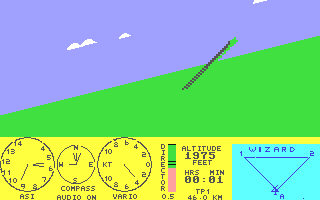 |
Please login to submit a screenshot
| Your Reviews |
|---|
 Issue 2, May 1985 (Zzap! 64) 17th Mar 2013 12:56
Last month we had a helicopter flight simulator and now we've got one for a glider. No roaring of engines or blasting of guns, just the rush of the wind as you cleave through the atmosphere.
Your task is to pilot your glider around a 160km triangular course in the fastest possible time. To do this you have to make the best use of the thermals (warm air currents) you find along the way, since these are your only source of lift.
You have the usual flying controls of nose up and down, bank left or right, plus open and close airbrakes. You also have an instrument display, showing your speed, height, rate of climb, angle, and a map of the course.
You start about 2000 feet up in the air and you can select whether you have to cross the starting line or not. This is an airfield, as are the other two turning points on the course, and the brave or foolhardy can try to land on them, which I haven't managed yet.
There are three main things to think about while flying: your direction, height, and speed. You want to follow the most direct route possible, at the greatest speed, and with the least possibility of crashing the glider. Your speed is determined by your nose angle and you can bank to change direction.
Maintaining height is altogether harder, until you get the hang of finding thermals. What you have to watch for are cumulous clouds that mark rising air columns, and fly towards them. Once your rate of climb becomes positive, you need to put your plane into a tight spin at about 40 knots to gain height as rapidly as possible. Depending on the 'inversion' height, the thermal will peter out between 2500 and 5000 feet.
Hopping between thermals you pass each turning point, until you arrive back at the starting point. Crossing the airfield here finishes your task, although trying to land is a difficult but enjoyable problem.
Once you have completed a flight, you are given a readout of your time and average speed and also a barograph of your progress as you glided down and then climbed again.
There are various pre-set weather conditions, or you can alter them yourself by determining inversion height, thermal strength, thermal frequency, thermal difficulty, wind strength, and wind direction. You can also determine the simulator speed from real time to four times faster, although it's not advisable to try and land at four times normal time.
There are some annoying sound effects to the instruments, but these can be switched off and the title tune is excellently atmospheric.
BW
Advanced flying
Experienced pilots might like to employ the techniques at the back of the flight manual. When starting, climb high and then dive underneath the maximum height of 3281 feet to start, pulling up to regain height afterwards. Also, when finishing try to glide in as low as possible so as not to waste time climbing earlier.
The key to making fast time is to climb as rapidly as possible and not waste time in weak thermals gaining little height. Also use the flight director to get the best possible speed between thermals, flying faster in sinking air and slower in rising air.
I suppose if you want or would like to soar around the heavens in a glider for hours on end, then yes, this is for you. Otherwise steer well clear of this flight simulator, as you may well find yourself becoming more than a trifle bored. I found little to appeal to me, other than the atmospheric and soothing music and the reasonably effective graphics. Even the act of crashing failed to spark off any stimulation in this boring simulation.
PRESENTATION
73% Helpful instructions and great barograph chart.
ORIGINALITY
52% We've seen flight simulators, but not for gliding.
GRAPHICS
47% Jerky cloud movement and little else.
HOOKABILITY
24% Long uneventful flights prove boring.
SOUND
23% Ear-numbing alarm noises but atmospheric title tune.
LASTABILITY
38% Fine for experts but little to interest the rest of us.
VALUE FOR MONEY
31% Unlikely to interest non-gliders.
Your task is to pilot your glider around a 160km triangular course in the fastest possible time. To do this you have to make the best use of the thermals (warm air currents) you find along the way, since these are your only source of lift.
You have the usual flying controls of nose up and down, bank left or right, plus open and close airbrakes. You also have an instrument display, showing your speed, height, rate of climb, angle, and a map of the course.
You start about 2000 feet up in the air and you can select whether you have to cross the starting line or not. This is an airfield, as are the other two turning points on the course, and the brave or foolhardy can try to land on them, which I haven't managed yet.
There are three main things to think about while flying: your direction, height, and speed. You want to follow the most direct route possible, at the greatest speed, and with the least possibility of crashing the glider. Your speed is determined by your nose angle and you can bank to change direction.
Maintaining height is altogether harder, until you get the hang of finding thermals. What you have to watch for are cumulous clouds that mark rising air columns, and fly towards them. Once your rate of climb becomes positive, you need to put your plane into a tight spin at about 40 knots to gain height as rapidly as possible. Depending on the 'inversion' height, the thermal will peter out between 2500 and 5000 feet.
Hopping between thermals you pass each turning point, until you arrive back at the starting point. Crossing the airfield here finishes your task, although trying to land is a difficult but enjoyable problem.
Once you have completed a flight, you are given a readout of your time and average speed and also a barograph of your progress as you glided down and then climbed again.
There are various pre-set weather conditions, or you can alter them yourself by determining inversion height, thermal strength, thermal frequency, thermal difficulty, wind strength, and wind direction. You can also determine the simulator speed from real time to four times faster, although it's not advisable to try and land at four times normal time.
There are some annoying sound effects to the instruments, but these can be switched off and the title tune is excellently atmospheric.
BW
Advanced flying
Experienced pilots might like to employ the techniques at the back of the flight manual. When starting, climb high and then dive underneath the maximum height of 3281 feet to start, pulling up to regain height afterwards. Also, when finishing try to glide in as low as possible so as not to waste time climbing earlier.
The key to making fast time is to climb as rapidly as possible and not waste time in weak thermals gaining little height. Also use the flight director to get the best possible speed between thermals, flying faster in sinking air and slower in rising air.
I suppose if you want or would like to soar around the heavens in a glider for hours on end, then yes, this is for you. Otherwise steer well clear of this flight simulator, as you may well find yourself becoming more than a trifle bored. I found little to appeal to me, other than the atmospheric and soothing music and the reasonably effective graphics. Even the act of crashing failed to spark off any stimulation in this boring simulation.
PRESENTATION
73% Helpful instructions and great barograph chart.
ORIGINALITY
52% We've seen flight simulators, but not for gliding.
GRAPHICS
47% Jerky cloud movement and little else.
HOOKABILITY
24% Long uneventful flights prove boring.
SOUND
23% Ear-numbing alarm noises but atmospheric title tune.
LASTABILITY
38% Fine for experts but little to interest the rest of us.
VALUE FOR MONEY
31% Unlikely to interest non-gliders.
| Cheats | Trivia |
|---|---|
| There are no cheats on file for this title. | No trivia on file for this title. |
History
This title was first added on 14th February 2013
This title was most recently updated on 17th March 2013