


Tenchu: Stealth Assassins (1998) 


| Details (Sony Playstation) | Supported platforms | Artwork and Media | |
|---|---|---|---|
| Publisher: Genre: Author(s): Maximum Players: Joysticks: Language: Media Code: Media Type: Country of Release: Related Titles: Comments: |  Activision Inc Activision IncAction Adventure / Fantasy Acquire SCPH-1010/1080 or Dual Shock SCPH-1200 controller Eng SLES-01374 DVD (Protected) USA, Europe, Japan Tenchu 2: Birth of the Stealth Assassins | Sony Playstation |
| Videos | Screenshots (Sony Playstation) |
|---|---|
| (no videos on file) | 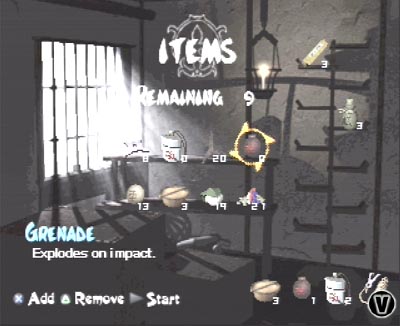   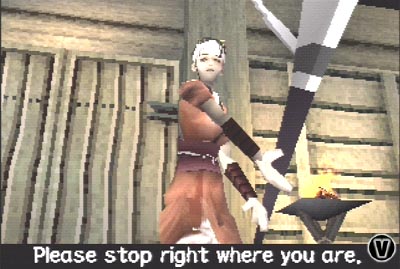  |
Please login to submit a screenshot
| Your Reviews |
|---|
 (Anonymous) (Playstation Review) 17th Apr 2012 04:59
"A great "ninja simulator"."
Tenchu is truly an idea whose time has come. Traditionally, videogames have misrepresented the ninja; Ninja Gaiden was just hack and slash, without a lot of finesse, and who can say how many nameless, faceless ''ninjas'' they've killed in any beat-em-up game. For their first project, Sony Music Entertainment Inc. re-evaluated the way a ''ninja game'' should play, and the result is one of the more creative games of the past few years.
Video: 8/20
Undoubtedly owing to the fact that its developer is a music company, not a game company, the graphics engine of Tenchu shows a lot of inexperience. Clipping and warping are all over the place, and the human characters are not only minimally detailed but often misshapen. On the plus side, the night-time setting of the game (all missions take place in the dark) allowed the best possible usage of the PSX's depth-cueing abilities to establish a convincing ''range of sight'', and there's the occasional effect, like gently falling snow in the fifth mission, that you might stop and look at for a moment.
Audio: 16/20
Undoubtedly owing to the fact that its developer is a music company, most of Tenchu's audio is handled perfectly. The music style is an interesting hybrid of more mainstream video game music and traditional Japanese music, but the composition has neither the forgettability of the former nor the inaccessibility of the latter. Subdued but not weak, it adds to the tension and atmosphere of the stages without overwhelming the action on-screen.
Sound effects are great, too. The soft patter of your ninja's feet, the howling of wolves in the distance, and the sound of your blade slitting your enemies' throats will all put you in the world of the ninja. Guards even occasionally exchange idle chatter.
Voice acting is, unfortunately, another story. Activision's localization is commendable for cleaning up the game's control and adding two new levels (possibly the best two levels in the game, at that), but clearly no time, effort, or budget was given to the dubbing of the game. What's worse is that, not content to merely be poor voice actors, many of the supporting VAs try to fake a Japanese ''accent'' in their speech, which results in an insulting, bordering on racist, depiction of the Japanese in the game. Thankfully (oh, so thankfully), Activision left a code in the game that will allow you to switch to subtitles of the original Japanese voices in those stages that aren't new for the American version. While I can't evaluate the quality of the original voice acting, anything would be better than the dismal production that is the English VA.
Control: 20/20
In a somewhat bold move, Tenchu doesn't elect to go with the all-seeing overhead camera of Metal Gear Solid. Instead, the camera follows your ninja, Tomb Raider-style, and controls are relative to your character (up to walk forward, left/right to turn). This works out very well--the ninjas travel at a suitable pace when running, and the camera (usually) doesn't get held up in the wrong place. Hold a ''look'' button to stand in the same place and move the camera around.
The key to the game is stealth, and this is accomplished simply and efficiently with a ''stealth'' button. Press and hold it when you're standing out in the open and you'll crouch; you can move slowly or roll in the crouch to creep around just out of sight of enemies. Hold the stealth button when near a wall, and your ninja will flatten against it MGS-style; move close to a corner and the camera will shift to the classic ''around-the-corner'' view. A built-in safeguard will keep you from actually going around the corner as long as the stealth button is being held. It doesn't take long to get used to the convention, and the only hiccup is that, for purposes of control, your character's facing is retained when up against a wall. This over-the-shoulder view, to me, provides a greater feeling of immersion than the overhead camera of MGS.
Finally, there's combat; you have a single attack button, and pressing it in conjunction with the D-pad (there's no analog support, by the way, but it works out fine), will give you various moves. There's not a huge library of these moves, and you'll likely find yourself over-relying on one or two of them, but the emphasis of the game is not on combat anyway; if you're fighting a lot of battles against enemies, you need to re-evaluate your strategy. How to avoid battles? Walk up to someone that hasn't detected you yet and simply press the attack button for a gruesome ''stealth kill'' that prevents retaliation and maintains your secrecy. Killing your enemies while remaining unseen is the goal of the game, and the control setup lends itself to this very well.
Gameplay: 34/40
As I said in the introduction, Tenchu is a game idea whose time has come. It's a bona fide attempt at a ''ninja simulator'': you, the ninja, are given some kind of task (assassinate this person, deliver a message, etc.) and need to accomplish it without being seen by the enemies that patrol the area. Stages are huge and sprawling; expect to take upwards of half and hour to traverse one, if you proceed slowly and meticulously enough to not be spotted.
Enemies' awareness of you, and yours of them, is provided in a small ''spidey sense'' meter in the corner of the screen. A number, from 0-100, tells you how close the nearest enemy is to you, and a symbol tells you the enemy's awareness (oblivious, suspicious, investigating, or on full alert). This is a great system for giving you a lot of information in a small space, but the AI of the enemies it's describing is somewhat flawed. They won't call their buddies to help them investigate or if they spot you; an enemy soldier that spots the dead body of an ally will get spooked and look around frantically for you for a while, but eventually return to his patrol route, instead of alerting someone else.
But if the enemies' actions are rather restricted, one of the beauties of Tenchu is in your freedom. You could lurk in a riverbed or hang off the edge of a cliff until an enemy walks by. Want to crouch on a rooftop, then swoop down like a bird of prey on your unsuspecting quarry? Go for it. Each enemy to be killed is like a puzzle; understand the pattern of his patrol, then use the surrounding environment and the tools you have to your best advantage to finish him off undetected. While it involves a lot of waiting, watching, and thinking, it's also immersive, addictive, and a total rush when you do it right.
Not only is the experience of playing Tenchu a sublime one, but the game's rewards for gameplay accomplishments are substantial as well. You're ranked on your performance on each mission; complete a mission, even with a lowly Thug rating, and you'll unlock the next one. Attaining the highest rank of Grand Master, which usually involves tackling the entire mission without being spotted, provides you with a new tool or item to take along on future missions. Seeing all the secret items kept my interest enough to not just finish the game, but earn Grand Master on all the levels, which extended the playtime of the game by a factor of at least five. As if that wasn't enough, there are two selectable characters, two difficulty levels, and each mission has three different ''layouts'', chosen randomly or selectable with a code. With all these variables, Tenchu's mere ten missions become something you can stick with for the long haul if you're the completist type.
Overall: 79/100
While I hesitate to use the word ''revolutionary'', Tenchu is one of those games that really needed to be made. It's held back by its mediocre presentation on some levels, but in the end it's a game that really puts you into the mind and world of a ninja, and that's what counts. Hopefully other developers will sit up and take notice of Tenchu, and refine its formula in future games.
Reviewer's Score: 8/10, Originally Posted: 12/28/00, Updated 04/25/01
Tenchu is truly an idea whose time has come. Traditionally, videogames have misrepresented the ninja; Ninja Gaiden was just hack and slash, without a lot of finesse, and who can say how many nameless, faceless ''ninjas'' they've killed in any beat-em-up game. For their first project, Sony Music Entertainment Inc. re-evaluated the way a ''ninja game'' should play, and the result is one of the more creative games of the past few years.
Video: 8/20
Undoubtedly owing to the fact that its developer is a music company, not a game company, the graphics engine of Tenchu shows a lot of inexperience. Clipping and warping are all over the place, and the human characters are not only minimally detailed but often misshapen. On the plus side, the night-time setting of the game (all missions take place in the dark) allowed the best possible usage of the PSX's depth-cueing abilities to establish a convincing ''range of sight'', and there's the occasional effect, like gently falling snow in the fifth mission, that you might stop and look at for a moment.
Audio: 16/20
Undoubtedly owing to the fact that its developer is a music company, most of Tenchu's audio is handled perfectly. The music style is an interesting hybrid of more mainstream video game music and traditional Japanese music, but the composition has neither the forgettability of the former nor the inaccessibility of the latter. Subdued but not weak, it adds to the tension and atmosphere of the stages without overwhelming the action on-screen.
Sound effects are great, too. The soft patter of your ninja's feet, the howling of wolves in the distance, and the sound of your blade slitting your enemies' throats will all put you in the world of the ninja. Guards even occasionally exchange idle chatter.
Voice acting is, unfortunately, another story. Activision's localization is commendable for cleaning up the game's control and adding two new levels (possibly the best two levels in the game, at that), but clearly no time, effort, or budget was given to the dubbing of the game. What's worse is that, not content to merely be poor voice actors, many of the supporting VAs try to fake a Japanese ''accent'' in their speech, which results in an insulting, bordering on racist, depiction of the Japanese in the game. Thankfully (oh, so thankfully), Activision left a code in the game that will allow you to switch to subtitles of the original Japanese voices in those stages that aren't new for the American version. While I can't evaluate the quality of the original voice acting, anything would be better than the dismal production that is the English VA.
Control: 20/20
In a somewhat bold move, Tenchu doesn't elect to go with the all-seeing overhead camera of Metal Gear Solid. Instead, the camera follows your ninja, Tomb Raider-style, and controls are relative to your character (up to walk forward, left/right to turn). This works out very well--the ninjas travel at a suitable pace when running, and the camera (usually) doesn't get held up in the wrong place. Hold a ''look'' button to stand in the same place and move the camera around.
The key to the game is stealth, and this is accomplished simply and efficiently with a ''stealth'' button. Press and hold it when you're standing out in the open and you'll crouch; you can move slowly or roll in the crouch to creep around just out of sight of enemies. Hold the stealth button when near a wall, and your ninja will flatten against it MGS-style; move close to a corner and the camera will shift to the classic ''around-the-corner'' view. A built-in safeguard will keep you from actually going around the corner as long as the stealth button is being held. It doesn't take long to get used to the convention, and the only hiccup is that, for purposes of control, your character's facing is retained when up against a wall. This over-the-shoulder view, to me, provides a greater feeling of immersion than the overhead camera of MGS.
Finally, there's combat; you have a single attack button, and pressing it in conjunction with the D-pad (there's no analog support, by the way, but it works out fine), will give you various moves. There's not a huge library of these moves, and you'll likely find yourself over-relying on one or two of them, but the emphasis of the game is not on combat anyway; if you're fighting a lot of battles against enemies, you need to re-evaluate your strategy. How to avoid battles? Walk up to someone that hasn't detected you yet and simply press the attack button for a gruesome ''stealth kill'' that prevents retaliation and maintains your secrecy. Killing your enemies while remaining unseen is the goal of the game, and the control setup lends itself to this very well.
Gameplay: 34/40
As I said in the introduction, Tenchu is a game idea whose time has come. It's a bona fide attempt at a ''ninja simulator'': you, the ninja, are given some kind of task (assassinate this person, deliver a message, etc.) and need to accomplish it without being seen by the enemies that patrol the area. Stages are huge and sprawling; expect to take upwards of half and hour to traverse one, if you proceed slowly and meticulously enough to not be spotted.
Enemies' awareness of you, and yours of them, is provided in a small ''spidey sense'' meter in the corner of the screen. A number, from 0-100, tells you how close the nearest enemy is to you, and a symbol tells you the enemy's awareness (oblivious, suspicious, investigating, or on full alert). This is a great system for giving you a lot of information in a small space, but the AI of the enemies it's describing is somewhat flawed. They won't call their buddies to help them investigate or if they spot you; an enemy soldier that spots the dead body of an ally will get spooked and look around frantically for you for a while, but eventually return to his patrol route, instead of alerting someone else.
But if the enemies' actions are rather restricted, one of the beauties of Tenchu is in your freedom. You could lurk in a riverbed or hang off the edge of a cliff until an enemy walks by. Want to crouch on a rooftop, then swoop down like a bird of prey on your unsuspecting quarry? Go for it. Each enemy to be killed is like a puzzle; understand the pattern of his patrol, then use the surrounding environment and the tools you have to your best advantage to finish him off undetected. While it involves a lot of waiting, watching, and thinking, it's also immersive, addictive, and a total rush when you do it right.
Not only is the experience of playing Tenchu a sublime one, but the game's rewards for gameplay accomplishments are substantial as well. You're ranked on your performance on each mission; complete a mission, even with a lowly Thug rating, and you'll unlock the next one. Attaining the highest rank of Grand Master, which usually involves tackling the entire mission without being spotted, provides you with a new tool or item to take along on future missions. Seeing all the secret items kept my interest enough to not just finish the game, but earn Grand Master on all the levels, which extended the playtime of the game by a factor of at least five. As if that wasn't enough, there are two selectable characters, two difficulty levels, and each mission has three different ''layouts'', chosen randomly or selectable with a code. With all these variables, Tenchu's mere ten missions become something you can stick with for the long haul if you're the completist type.
Overall: 79/100
While I hesitate to use the word ''revolutionary'', Tenchu is one of those games that really needed to be made. It's held back by its mediocre presentation on some levels, but in the end it's a game that really puts you into the mind and world of a ninja, and that's what counts. Hopefully other developers will sit up and take notice of Tenchu, and refine its formula in future games.
Reviewer's Score: 8/10, Originally Posted: 12/28/00, Updated 04/25/01
| Cheats | Trivia |
|---|---|
| There are no cheats on file for this title. | No trivia on file for this title. |
History
This title was first added on 13th October 2006
This title was most recently updated on 17th April 2012